Friday, March 29, 2019

Juan Antonio Bayona: The Orphanage

Director: J.A. Bayona
Writer: Sergio G. Sanchez

Plot:

A woman brings her family back to her childhood home, which used to be an orphanage for handicapped children. Before long, her son starts to communicate with an invisible new friend. - IMDB.com

Cast                                                             Character

Belen Rueda                     ...                        Laura
Fernando Cayo                 ...                        Carlos
Roger Princep                   ...                       Simon
Mabel Rivera                    ...                       Pilar
Montserrat Carulla            ...                       Benigna
Andres Gertrudix              ...                        Enrique
Edgar Vivar                       ...                       Prof. Leo Balaban
Oscar Casas                       ...                       Tomas
Mireia Renau                    ...                        Laura nina
Georgina Avellaneda        ...                        Rita
Carla Gordillo                   ...                        Martin
Alejandro Camps             ...                         Victor
Carmen Lopez                  ...                        Alicia
Oscar Lara                         ...                       Guillermo
Geraldine Chaplin             ...                       Aurora

Thoughts:

The film opens top at Good Shepherd Orphanage. One girl is about to be adopted. Her name is Laura. Simone has a bad dream and is comforted by his mother, Laura. The ghosts are trying to communicate with Simon.

Laura is reopening the orphanage for disabled children. Simon has two invisible friends, Watson and Pepe. These are ghosts that he sees. His parents are concerned about his invisible friends. Simon goes to a cave near a lighthouse. Simon talks to his invisible friend in the cave and the mother, Laura sees footsteps where the invisible friend was. Simon doesn't know he is HIV Positive or that he's adopted. He is also on medication.

The seashells that Simon left for his invisible friend to follow him are all stacked by the front door which Laura sees.

Simon tells his mom, Laura, he is not going to get older like his 6 invisible friends. The invisible friends leave clues for Simon to find a treasure and make a wish. He finds some coins in the drawer Laura locks his medical file. They argue and he says he knows she's not his mother. At the welcoming party people wear creepy masks and the children arrive. A kid with a strange sack mask follows Laura and locks her in the bathroom. After getting out she frantically looks for Simon. They can't find him.

At the emergency room Laura is introduced to Pilar, a police psychologist. Carlos gives Laura his Saint Anthony medallion necklace that belonged to his grandmother. He is the patron saint of lost things. She has a dream of swimming in the water. Now in a wheelchair she hears the whistle of one of Simon's invisible friends. The house is haunted.

Simon now has been missing for 6 months. She believes he is still alive. Benigna gets run over by a car and it is revealed she worked at the orphanage and her son was there who was deformed. Laura remembers the same boy who had a sack mask at the party but no one else remembers him.

After talking to a professor he suggests a medium he knows to help her. She visits the house sensing the spiritual presence. She sees five children who are sick and dying. These are ghosts that only Aurora (played by Geraldine Chaplin) can see but they can be heard by everyone. Aurora tells Laura to believe and she will see.

Laura is desperate to reach her son. Carlos thinks the medium put on a show. Later Laura finds skeletal remains in a cabinet in their shed outside. In the bags we are to assume she found the skeletal remains of all 5 orphan children that were there before. Their names were Martin, Rita, Alicia, Guillermo and Victor. Laura knew them as a child. Benigna killed them. That's why she went to the shed, to recover their bodies.

Carlos leaves Laura in the house for two days as asked by her. She tries to make peace for the ghosts in exchange to find her son. She plays a game of tag and sees them physically. There are 4 of them. She gets trapped in a closet which a ghost girl led her there. She puts the door handle in a hole in the wall and opens a secret door to stairs going down.

She finds Simone and he tells her to stay and play with the children. He disappears as if he wasn't there. She finds his dead body. The lighthouse shines a light through the window and she sees herself as a child running outside. His body comes back to life and Simon is alive. The ghosts see Laura and recognize her and say she's grown old. These are the children she knew when she was a child. She tells them a nighttime story. Laura eventually dies and Carlos finds the St. Anthony medallion on the ground as the doors open by the wind or presence of Laura trying to communicate with him.

The movie is good about secrets needing to be shown to make peace with the souls of the dead.

Works Cited:

https://www.rogerebert.com/reviews/the-orphanage-2007
https://www.imdb.com/title/tt0464141/?ref_=nv_sr_1
https://www.imdb.com/title/tt0464141/trivia?ref_=tt_ql_2
http://www.archbishopcurley.org/about/article/st.-anthony-lost-items

Monday, March 25, 2019

Brian De Palma: Scarface

Director: Brian De Palma
Writer: Oliver Stone

Cast                                                 Character

Al Pacino                ....                    Tony Montana
Steven Bauer          ...                      Manny Ribera
Michelle Pfeiffer    ....                     Elvira
Mary Elizabeth Mastrantonio  ...    Gina
Robert Loggia        ...                      Frank Lopez
Miriam Colon        ...                      Mama Montana
F. Murray Abraham    ...                 Omar
Paul Shenar                ...                  Alejandro Sosa
Harris Yulin                ...                 Bernstein
Angel Salazar            ...                  Chi Chi
Arnaldo Santana        ...                  Ernie
Pepe Serna                ...                   Angel


Plot:

In Miami in 1980, a determined Cuban immigrant takes over a drug cartel and succumbs to greed.  - IMDB.com

Thoughts:

Scarface is an intensely violent movie with tons of F-bombs and Machismo as well. It is a great study on uncontrollable greed and violence to attain the American Dream no matter how excessive it may be. It reminds me of Hollywood celebrities who have it all but want more and more of the physical pleasures and material things while neglecting their spiritual life if they even have one. "According to AMC's "DVD TV: Much More Movie" airing, Cher loved the film; Lucille Ball came with her family and hated it because of the graphic violence and language; and Dustin Hoffman was said to have fallen asleep. Writers Kurt Vonnegut Jr. and John Irving were among those who allegedly walked out in disgust after the notorious chainsaw scene. At the middle of the film, Martin Scorsese turned to Steven Bauer and told him, "You guys are great - but be prepared, because they're going to hate it in Hollywood... because it's about them."[24]" - IMDB.com The big question one might ask is this ruthlessness to succeed is it parallel to the belief one could sell their soul to advance in this physical world we live in?

The machismo is on full throttle as everyone tries to overthrow the other in a battle of manliness. Like Oliver Stone's Wall Street you have to ask how much is enough? How many cars, women and cash do you need to feel superior? 

The film opens up saying:

In May 1980, Fidel Castro opened the harbor at Mariel, Cuba, with the apparent intention of letting his people join their relatives in the United States. Within seventy-two hours, 3,000 U.S. boats were headed for Cuba. It soon became evident that Castro was forcing the boat owners to carry back with them not only their relatives, but the dregs of his jails. Of the 125,000 refugees that landed in Florida an estimated 25,000 had criminal records.

Tony Montana tries to charm his way with the agents who are questioning him. He has a tattoo on his hand that means he was an assassin. Manny and Tony are promised Green Cards if they kill a guy called Emilio Rebenga. Tony does the deed and proves quite early what a sociopath he really is. 

The two meet Omar Suarez. After an argument over not getting paid enough Tony gets an offer to buy 2 kilos of cocaine and get he and Manny get $5,000. Already Tony shows what a greedy little shit he is. 

Hector who tries to sell his the coke sets him up and tries to kill Tony but Tony gets away killing him on the street. Angel is killed but Frank Lopez gets to keep the money and drugs. At the Babylon Club, Frank Lopez tells Tony don't underestimate the other guys greed. Elvira tells Tony Rule 2 don't get high on your own supply. Elvira breaks rule 2 as a full blown drug addict. 

Tony describes Miami Beach as paradise. He says, "This town's like a great big pussy just waiting to get fucked." After trying to pick up a woman Manny is told, "In this country, you gotta make the money first. Then when you get the money, you get the power. Then when you get the power, then you get the women." The film is very quotable as everyone who has watched it knows. It has some 1980s trappings like a shallow soundtrack but it works in the selfish setting it takes place. 

Elvira describes Tony's Cadillac when being picked up to see Frank as "somebody's nightmare." He forces a kiss on her and this is really the only intimacy we see in the film between the two. Elvira's addiction is cocaine and Frank's addiction is greed. 

Tony meets up with Gina and their mom. Tony is borderline in love with his sister. Tony tries to give his mom a $1,000 but she rejects it saying, "It's Cubans like you who are giving a bad name to our people." The mom is strong but Gina is weak seduced by the charms of Tony and his money.

Suarez and Tony meetup with Sosa in Bolivia to be offered to buy 150 kilos of coke a month. "The tension between Tony and Omar peaks when Tony tries to negotiate unauthorized terms with Sosa. Omar leaves, but Sosa asks Tony to stay. As Tony and Sosa discuss business, Sosa discloses to Tony that Omar is a chivato (police informant), who years before whistled out on some of Sosa's business partners in New York. " (https://scarface.fandom.com/wiki/Home_Page)

Frank cannot accept the fact that Omar was an informant. He doesn't believe it. Later Bernstein, a narcotics officer, meets with Tony expecting some bribes every month since he's big time now. He tells him, "Every day above ground is a good day."

Two assassins try to kill Tony with Uzis but fail. He escapes fast with his Porsche. Frank Lopez was behind it and is disposed of by Manny accordingly. Tony shoots and kills Bernstein, the crooked cop and Ernie is offered a job by Tony. 

A blimp outside has the marquee that says "The World is Yours." Tony watches this. 

The just like blimp says the world is Tony's and he is able to buy Gina her own beauty salon shop and brings huge bags of cash to deposit in the bank. He marries Elvira and shows off the tiger he bought. It's ironic he gets married by a priest under the eyes of God considering he does nothing virtuous in his life. 

In a great shot that shows Elvira's addictions worsening is when she drinks alcohol, smokes a cigarette and snorts cocaine. In his tub Tony is mad about getting charged 10 percent to launder his money at the bank. He says, "You know what capitalism is? Getting fucked." 

When counting money that Tony Montana is laundering one guy fans himself with money. That is how ridiculously rich they all are. Tony is set up by cops and is told he has violated the Rico statute. 

Tony Montana makes a good point about the limitations of money by saying you snort, fuck, suck, eat and drink. Is this what it's all about he says. Elvira and Tony get into an argument and Elvira says, "We're not winners. We're losers."

Tony works with a crew of three people in his car after they put a bomb in a journalist car waiting for the right time to detonate the bomb. They see he picks up his wife and kids which Tony doesn't like. He doesn't want to kill women and children. This is the only humanity Tony has other than his superficial charm. The guy they were supposed to kill finds the bomb under the car and now has huge security. Sosa is pissed because they blew the one opportunity to silence this guy. 

Tony goes to Gina's house on Citrus Drive and finds Manny there. He shoots him pissed because he told him not to get involved with his sister. Back at his mansion Sosa's men are seen climbing the fence to kill Tony. His sister, Gina, wants him to admit he loves her in an unnatural way. She is killed by one of Sosa's men. Tony kills him in turn. 

Tony talks to Gina's corpse and gives it a kiss as if she's alive. He tells her he'll be back. This shows his dissociative state from reality. He is also plenty high on cocaine. 

In a shootout Tony kills several men at first and takes so many bullets while he is alive it is a bit cartoonish. He holds his gun between his legs like it is a penis that can shoot bullets. Ironic since the only person he sleeps with in the film is Elvira. Sex is one thing he lacks although it seems he has everything else. He is eventually killed by The Skull behind him by shotgun blast. 

The film is dedicated to Howard Hawks and Ben Hecht 

Trivia:

Oliver Stone wrote the script for Scarface while struggling with his own addiction to cocaine. -Wikipedia

Scarface was actually a nickname of Al Capone who was an Italian-American gangster. - IMDB.com

Tony's reference to "my little friend" when describing his tricked-out assault-weapon is also a reference to his drug-addiction --- this term is often used to refer to a bad habit, personal weakness, or irritating problem/situation; it is often jokingly described as an "invisible friend", just as the famous "little man upon the stair" refers to the poet's having mood/concentration-altering hypoglycemia. Or for another "classic" example, if a machine has an intermittent malfunction and/or sometimes produces an inexplicable noise/vibration/odor, the operators will say, "Our little friend is back" whenever the issue occurs. - IMDB.com

For all the love and desire that Tony professes to have for Elvira, you never actually see them kiss or have any type of physical intimacy. He tries to forcibly kiss her in the car, where she stops him and backs him off. Then, even during their wedding ceremony, you don't actually see them kiss, although it is simulated and obscured by her veil and a fake "Hollywood movie kiss". That's about as close as they get to any resemblance of intimacy. - IMDB.com

Final Thoughts:

Scarface is a good movie but it is detrimental to the image of Cubans and Cuban Americans. That being said it's just a movie but still.

Works Cited:

IMDB.com
http://remezcla.com/features/film/scarface-cuban-representation-35th-anniversary/
https://en.wikipedia.org/wiki/Scarface_(1983_film)
https://www.imdb.com/title/tt0086250/trivia?ref_=tt_ql_2
https://scarface.fandom.com/wiki/Home_Page


Sunday, March 24, 2019

Wolfgang Petersen: Troy

Director: Wolfgang Petersen
Writers: Homer (poem), David Benioff (screenplay)

Cast                                       Character

Julian Glover             ...        Triopas
Brian Cox                  ...        Agamemnon
Nathan Jones             ...        Boagrius
Adoni Maropis          ...        Agamemnon's Officer
Jacob Smith              ...         Messenger Boy
Brad Pitt                   ...         Achilles
John Shrapnel            ...        Nestor
Brendan Gleeson       ...        Menelaus
Diane Kruger             ...        Helen
Eric Bana                   ...        Hector
Orlando Bloom          ...        Paris
Siri Svegler                ...        Polydora

Plot:

An adaptation of Homer's great epic, the film follows the assault on Troy by the united Greek forces and chronicles the fates of the men involved.    - IMDB.com

Storyline

It is the year 1250 B.C. during the late Bronze age. Two emerging nations begin to clash after Paris, the Trojan prince, convinces Helen, Queen of Sparta, to leave her husband, Menelaus, and sail with him back to Troy. After Menelaus finds out that his wife was taken by the Trojans, he asks his brother Agamemnon to help him get her back. Agamemnon sees this as an opportunity for power. So they set off with 1,000 ships holding 50,000 Greeks to Troy. With the help of Achilles, the Greeks are able to fight the never before defeated Trojans. But they come to a stop by Hector, Prince of Troy. The whole movie shows their battle struggles and the foreshadowing of fate in this remake by Wolfgang Petersen of Homer's "The Iliad."Written by Mensur Gjonbalaj (IMDB.com)

Thoughts:

Our story of Troy begins 3,200 years ago in Greece. Two opposing armies, the Trojans and Greeks, meet in Thessaly. Agamemnon taunts his enemy saying his opponents soldiers and land will belong to him. They agreed to have both sides fight with their best fighters. One against one.

When Achilles is found he tells his king, "Imagine a king would fight his own fights. Wouldn't that be the sight?" Very True. Achilles is the son of Peleus. Achilles doesn't respect his king. At Sparta there is a feast. Paris seduces a beautiful blonde woman named Helen. He sneaks her on boat with the Trojans and because of that Hector is mad. They have to return Helen to Troy.

Achilles is tempted by glory to fight in another war to have his name immortalized. His mother tells him he can have a family that loves him or eternal glory through war and death. She tells him, "The world will remember your name."

Menelaus wants to track Paris and Helen down. Achilles is on his way by boat to take Troy. Archers with fire arrows kill several of Achilles's men. Achilles after storming the beach says the men can take any treasure they can find. The Greeks and Trojans fight. To put it bluntly Achilles is not a humble soldier but he can fight and kill well.

Agamemnon shows the "spoils of war" which is a slave girl he found in the temple who tells Achilles, "If killing is your only talent, that's your curse."

The Greeks approach the city of Troy. Their army is massive. Paris fights Helen's former husband. Paris is beaten. He cowers to his brother like the coward he is. His opponent says, "This is not worthy of royalty." The Greeks charge for Troy and the Trojan archers kill a lot of Greeks. Eventually the Greeks retreat. The Greeks put a coin on the dead's eyes. "Greek and Latin sources specify the coin as an obol, and explain it as payment or bribe to Charon, the ferryman who conveyed souls across the river that divided the world of the living from the world of the dead." (Wikipedia) Hector fights for his country. Achilles fights only for himself.

Because Achilles desecrated a Trojan god the Trojans feel the Greeks are cursed and should be attacked. Hector attacks and kills Achilles's cousin thinking t was him. Hector is challenged by Achilles at the city gate. Hector goes to meet him. Achilles kills him within minutes. Achilles told him he would cut out his eyes and ears so he would be blind and deaf in the underworld.

Priam goes to Achilles and begs him to get the body of Hector in order to give him a proper burial. The face is mutilated of Hector. Achilles cries out of guilt to what he did to Hector's face. Priam and Paris burn the body.

A wooden horse is given to the Trojans. People celebrate the gift. A Trojan scout sees that the ships of Greece are still there. He is killed by arrows. Inside the horse the Greeks and Achilles emerge at night. They open the gate and the Greeks enter Troy.

Helen and others escape by the secret tunnel. The Greeks show no class in desecrating the gods. Achilles's heel is hit by Paris's arrow. He shoots Achilles in the stomach as well. Achilles tells Briseis, "You gave me peace in a lifetime of war." She is devastated. Achilles dies as does Troy. The Trojans bury the body of Achilles with class without mutilating the body like Achilles did to Hector. 

Thursday, March 21, 2019

Rob Marshall: Nine

Nine 

Director: Rob Marshall

Writers: Michael Tolkin, Anthony Minghella, Arthur Kopit, Maury Yeston and Mario Fratti


Cast:

Daniel Day-Lewis         …            Guido Contini 
Sandro Dori                    …           Studio Superintendent
Nicole Kidman              …           Claudia
Marion Cotillard          …            Luisa Contini
Penelope Cruz.            …            Carla
Judi Dench                     …           Lilli
Sophia Loren                …           Mamma
Kate Hudson                 …            Stephanie
Fergie                             …            Saraghina

I'm just a storyteller, and the cinema happens to be my medium. I like it because it recreates life in movement, enlarges it, enhances it, distills it. For me, it's far closer to the miraculous creation of life than, say, a painting or music or even literature. It's not just an art form; it's actually a new form of life, with its own rhythms, cadences, perspectives and transparencies. It's my way of telling a story. 

-Federico Fellini 

             GUIDO
            You kill your film several times,
            mostly by talking about it. A film is
            a dream. You kill it writing it down,
            you kill it with a camera; the film
            might come to life for a moment or two
            when your actors breathe life back
            into it - but then it dies again,
            buried in film cans. Mysteriously,
            sometimes, in the editing room, a
            miracle happens when you place one
            image next to another so that when,
            finally, an audience sits in the dark,
            if you're lucky -- very lucky - and
            sometimes I've been lucky - the dream
            flickers back to life again. That's
            why I'm secretive.

                         REPORTER (O.S.)
            So what's your favorite pasta?

                         GUIDO
            Finally, a serious question.

Guido in Nine is our Federico Fellini. He is both tormented and enamored by women. There are many in this film that get to him. Contini enters Cinecitta Film Studios in Rome 1965. Claudia enters in, one of his muses and many others. The sets are pretty incredible in this film. Everyone hounds Contini for solutions to the problems of filmmaking. He is stressed and busy. Lilli tells him a director's job is just to say yes or no to everything. The Italian scenery is quite picturesque. A banker called Fausto hounds Contini over a plan and budget for the film.

Guido Contini sings he wants everything arranged for him. Earlier at the press conference is a reporter who asks if he has anything left to say. I am sure this is a fear and reality many film directors have. At the hotel he wants his wife, Luisa to be with him. In his room Carla calls and sings all sorts of sexual innuendo she wants to do to him raising his heart beat worrying his doctors. 

Carla arrives by train wearing red like temptation itself and is Contini's mistress. "Penelope Cruz's character, Carla Albanese, is based on Giovannini, the long-time mistress of director Federico Fellini." -IMDB.com After sex Guido puts the crucifix in the nightstand perhaps out of guilt. Contini is suffering from writer's block and being distracted by a bunch of women doesn't help. 
Guido Contini talks to a priest and is asked if he is a Catholic. Guido says not as much as would like to be. The priest says to try harder. The priest asks do people need to see so much sex in Contini's films. It's not necessary. He tells Contini, imagination is God's garden. Don't let the Devil play in it. He tells Contini, "Teach our Italian women to be wives, not whores."
Later the producer tries to calm people at dinner because Contini, the director, doesn't have a script yet. This Segways to Luisa singing about Guido having dreams about some romantic theme. She sings he can't distinguish what's his work and what's his home. She sings she is his number one fan. This is sad because Guido loves her when it is convenient for him and is frequently cheating on her in one form or another. 

When Carla comes Luisa leaves angrily at Guido. She is angry at his lies and cheating. 
Stephanie sees Guido at the bar and says she's seen his movies like a million time. This starts the song and dance scene. He meets her at her hotel room with the key he is given. He leaves instead and goes to his wife. Getting a phone call Guido is called to Carla's room who makes herself sick by taking 5 or 6 pills. The doctor says this is a sordid business with movie people concerning having a mistress. 

Claudia wants a script for the movie as everyone else. She reveals he doesn't know how to love and that he has a wife who loves him. 

Luisa in a dance and song shows her inner desire to get back at Guido by being provocative with other men. She thinks he is just an appetite and greedy. She is upset the ways he flirts with the ladies on his film set. Luisa says it's hopeless. Their marriage is over. 

Guido tells his film crew there is no movie. Luisa is later shown with another man after being split from Guido two years later. He meets with Lilli and tells her the only movie he could do now is about a man trying to win back his wife. He begins working on his next film called "Nine."


Final Thoughts:

All in all Nine is a good movie and a fun one at that. The only thing is the film lacks a depth that the film 8 1/2 has which it is based on. The sets aregreat and the singing too.  


Works Cited:

www.imdb.com
https://www.imsdb.com/scripts/Nine.html

Sunday, October 14, 2018

Terry George: The Promise

Director – Terry George
Writers – Terry George, Robin Swicord


Plot: Set during the last days of the Ottoman Empire, The Promise
follows a love triangle between Michael, a brilliant medical student,
the beautiful and sophisticated Ana, and Chris - a renowned American
journalist based in Paris. – IMDB.com

Cast                                                    Characters
Oscar Isaac                  …                Mikael Boghosian
Charlotte Le Bon        …                  Ana Khesarian
Christian Bale              …                Chris Myers
Daniel Giménez Cacho      …        Reverend Dikran Antreassian
Shohreh  Aghdashloo        …        Marta Boghosian
Marwan Kenzari            ---            Emre Ogan
Angela Sarafyan            …            Maral
Tom Hollander              …              Garin
Numan Acar                  …            Mustafa
Igal Naor                        …            Mesrob
Milene Mayer                …            Yeva
Tamer Hassan                …            Faruk Pasha
Alicia Borrachero          …          Lena
Abel Folk                      …            Harut
Jean Reno                      ---            Admiral Fournet

Thoughts –  The movie starts saying “On the eve of World War I, the
once vast Ottoman Turk Empire was on the brink of collapse. The fate
of the Empire’s Greek, Assyrian, and Armenian minorities lay in the
balance”
We begin in Siroun, Southern Turkey 1914. It is half Turk, half
Armenian. Mikael Boghosian is a man who prepares and sells medicines.
The narrator tells us “For 200 years the  Boghosians made medicines
using formulas handed down from our ancestors. We treated everyone
alike, Muslim and Christian, rich and poor.” Harut, Mikael’s father in
law, gives him 400 gold coins as a dowry. He says he will grow to love
her so it is a marriage for money so he can go to school in
Constantinople to study medicine.
At the Imperial Medical School Mikael begins classes. This is his
dream come true.  Mikael notices and talks to Ana Khesarian who is an
artist. We are introduced to Christopher Myers played by Christian
Bale who sis a Paris based American journalist. They agree the place
is boring where they are drinking and they go to a bar to drink
absinthe.
Ana tells Mikael she’s done sketches for Parisian magazines and
American newspapers. Ana is with Christopher but a love triangle is
brewing. Chris apologies for insulting the Turk and German armies at
the party to Ana.  Turkey enters the war October 29, 1914. Mikael
avoids a military draft when his friend pays off a soldier who enlists
people. That was a close call.  Chris tells Ana it’s not safe for
Armenians right now so he wants to get her an American visa. Mikael’s
uncle recognizes that Ana likes Mikael and that things are not good
between her and Chris. He suggests to Mikael he get divorced and pay
back the dowry of 400 gold coins plus 200 to ease the anger. Mikael
says no he made a promise. Chris witnesses Armenian’s being marched to
their deaths, The Armenian Genocide, and one woman weak is shot. Turks
are assaulting Armenians and setting fire to their shops.
An affair starts with Ana and Mikael. As a journalist Chris wires a
message to New York that Armenians are being murdered. The Turks don’t
like this when they hear him aloud. He is also mad because he knows
Ana cheated on him with Mikael. Emre, a Turk, tries to help his
Armenian friend, Mikael. Mikael tries to bribe someone in the prison
but is tricked and imprisoned himself. Emre’s relative tells him he is
to join the army to restore their family name. Chris looks at his wife
Ana and knows she cheated on him. The Turks are building a railroad
and the Armenians are doing all the manual labor. The Turks are
brutal. They shoot someone if they are injured.
Mikael escapes the work camp. He gets help from some Armenian
peasants. Maral and Mikael get married in an Armenian ceremony. Mikael
is given refuge b his family. He sleeps with Maral. All in all he is
lucky. Chris tells a pastor he wants to record the orphans escaping
for posterity. The pastor agrees to it. Maral thinks she is pregnant
with Mikael’s child. Ana and Mikael reunite at the mission. They cry
seeing each other.
Chris asks how Mikael is going to introduce Ana to his wife, Maral. He
is threatening him. Mikael doesn’t like this. Mikael sees his family
captured by the Turks. The Turks kill a load of people by the river
and leave them there. Among them is Maral and Mikael’s father.
Turks come and find the survivors, Mikael’s mother and a little girl.
A Turk kicks Chris in the testicles and he is emasculated once again.
Chris Myers tells a Turk official, Faruk Pasha, he is reporting on the
war. The man says there is no war here just a civilian relocation.
Chris rips up a confession he gets in prison he is suppose to sign. It
shocks Emre. They find out Emre sent out information about Chris and
he is executed. Marta dies and they bury her under rocks. This was
Mikael’s mother.
Turks start firing canon balls on the mountain where the Armenians are
hiding. They head toward the beach. Admiral Fournet of the French Navy
sends help to the Armenians. They fight alongside the Armenians. Ana
and Mikael kiss and she says she loves him. Chris sees this.  Yeva and
Ana are tossed from the boat evacuating the Armenians. Ana drowns.
Chris finds out and he is devastated. Chris dies while reporting on
the Spanish Civil War.
The movie tells us, “One and a half million, men, women, and children
perished during the Armenian genocide. To this day the Turkish
government refuses to acknowledge this crime.”


Works Cited:

Jean-Luc Godard: Breathless


Director– Jean-Luc Godard

Writer - François Truffaut


Cast                                          Characters
Jean Seburg                          Patricia Franchini
Jean-Paul Belmondo            Michel Poiccard / Laszlo Kovacs
Daniel Boulanger                 Police Inspector Vital
Henri-Jacques Huet              Antonio Berrutti
Roger Hanin                         Carl Zubart
Van Doude                            Himself
Claude Mansard                     Claudius Mansard
Plot
A small-time thief steals a car and impulsively murders a motorcycle policeman. Wanted by the authorities, he reunites with a hip American journalism student and attempts to persuade her to run away with him to Italy. –IMDB.com

Introduction to French New Wave Facts
The French New Wave was consisted of two parts: the Cahiers group of critics-turned-directors (Claude Chabrol, Jean-Luc Godard, Jacques Rivette, Eric Rohmer, and Francois Truffaut) and the “Left Bank” group has often been characterized as taking literature, philosophy, politics, and the possibilities of documentary more seriously than the Cahiers group. They were also more professionally experienced filmmakers, and Varda’s La Pointe Courte (shot and privately premiered in 1954, released in 1956 and edited by Resnais) has been called by some the first New Wave film; it is certainly the precursor, as Ossessione prepared the way for Neorealism. (Mast Kawin 347)

Furthermore “To like Godard for Breathless is perhaps to wish he were another Truffaut. But even in Breathless the unique Godard devices – the logical assault against logic, the sudden and abrupt event, the detachment of the viewer from the illusion of the film – control the work. As Michel drives the stolen car, his lengthy monologue on life and the countryside is addressed directly to us, an artifice that Godard emphasizes with his jump cutting, which destroys – or excitingly charges the visual continuity of time and space. (Mast Kawin 352)

One technique that Godard is famous for is that of Breaking the Fourth Wall. This is seen is his film Band of Outsiders. It is jarring and abrasive and gets your attention. 

Thoughts
The film Breathless begins with Jean-Paul Belmondo looking at a sexy pin-up in a tabloid newspaper. You’ll see him stroke his lips a habit supposedly Humphrey Bogart had. “Breathless uses the famous techniques of the French New Wave: location shooting, improvised dialogue, and a loose narrative form. In addition Godard uses his characteristic jump cuts, deliberate “mismatches” between shots, and references to the history of cinema, art, and music. Much of the film’s vigor comes from collisions between popular and high culture: Godard shows us pinups and portraits of women by Picasso and Renoir, and the soundtrack includes both Mozart’s clarinet concerto and snippets of French pop radio.” (ThePirateBay)

“Breathless (À Bout de Souffle) was a “New Wave” film released in 1960 France and was directed by Jean-Luc Godard. The script was written by Godard and François Truffaut, both of whom were writers for the Cahiers du Cinéma, a journal for cinema.” (Film…And All Its Goodness)

Michel steals a car and is off. He breaks the fourth wall by talking to camera. He says if you don’t like the shore, mountains or city then get stuffed. He aims to the sun with his gun and we hear gunshots. The gunshots are not from the gun itself. As the editing continues as he is driving there is a cut on sound which gets your attention.  The cops chase him and he kills one escaping on foot through a field. When Michel is at a girlfriend’s apartment there is natural lighting and a wall light but it is shot seemingly without key, fill lights and back lighting. This gives it a rawer more individual and auteur look. “A tiny room in the Hotel de Suede was used as the room where Patricia lived. It was so small there was only about eight inches of floor space around the bed. Jean-Luc Godard, Raoul Coutard, and the actors all had to cram into the space, with the focus puller standing on the bed and the script supervisor watching through the door. "It was a relief not to have lights," Coutard later said.” (IMDB.com)

An interesting trivia fact is that “the story is based on the real life criminal, Michel Portail, who Truffaut had collected clippings back in 1952” (IMDB.com) Michel goes to a movie theatre and sees a picture of Humphrey Bogart and strokes his lips the way that Bogart seemingly does. Humphrey Bogart was a symbol of masculine power and Michel tries to emulate that. 

Godard’s status was cemented with the greats as this movie came out despite it’s unorthodox editing. This parodic re-appropriation of a classical thriller (dedicated to Monogram Pictures, the American B-movie production company) turned budgetary constraints to its advantage by using outdoor locations, natural lighting, a hand-held camera and a crew reduced to a minimum to create the impression of a more authentic, if stylized, approach to reality.” (Fotiade 12)

What is basically said in the last citation is that the budgetary constraints were an asset to the film adding forced methods of creativity for Godard to use. These are part of the reasons that this is a landmark film.
On a technical note “Coutard had no difficulties in adapting to Godard’s unconventional methods, and went along with the young director’s suggestion of using hypersensitive film stock (Ilford HPS and Agfa Record) for night shoots, which up until then had been the preserve of still photographers and documentary filmmakers. A different stock (Gervaert 36) was used for day shooting.” (Fotiade 32)

When Michel insists that Patricia sleep with him that night she basically turns him down. In the car there are many jump cuts probably to eliminate boring dialogue between Patricia and Michel as stated by Fotiade. The dolly shots I read were accomplished by a cameraman being pushed on a wheelchair. Creative. He scene in which Patricia and Michel talk in her room has natural lighting which gives the film a documentary type look. It adds realism as well as the outside location shooting. Patricia presumably sleeps with the man giving her articles to write which angers Michel understandably. Michel philosophizes women and what they want and is angry that Patricia doesn’t know if she loves him yet. He asks her if she thinks about death. He says he does all the time.  Fitting since death will await him at the end of the film. She tells him she’s pregnant. Every time he touches her butt she slaps him. Patricia says she wants to know what’s behind his face. Michel says he’s not much of a looker but he is quite the boxer. Jean-Paul Belmondo was a amateur boxer in real life. “The scene establishes an idiosyncratic non-verbal bond between characters that are otherwise constantly plagued by cultural misperceptions and linguistic quid pro quo.” (Fotiade 47)

Michel steals a Ford which he likes. Jean-Luc Godard can be seen spotting Michel and he is the one who informs the police on him. Michel takes the car to a chop shop but they rip him off on the price of the car. “Cutting between dialogue and splicing the shots of only one interlocutor ‘as if it was a single take’ (during Michel’s conversation with Patricia in the car) provides an example of stylistic innovation that helped solve a practical editing problem.” (Fotiade 63) These jump cuts make for a fluid conversation and scene as Michel asks her question and a time lapse is not really detected. 

Jump cut after jump cut of Michel cursing the taxi driver to speed up and pass cars shows his rude side as he now knows police are pursuing him. Antonio Berruti owes him money and he left 5 minutes ago as Michel tries to find him. 

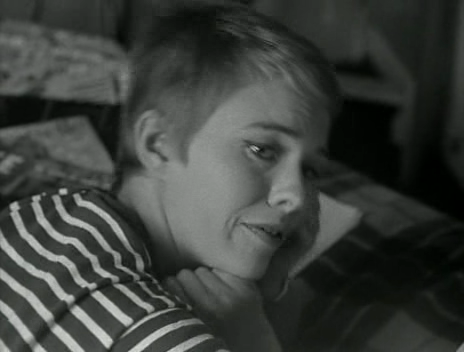
Continuity was a funny thing in the film. “At times Godard’s resentment of classical continuity rules went as far as to exclude Susanne Faye (the continuity girl) from the shooting, which led to glaring inconsistencies in the actors’ costumes, such as Patricia’s sudden change from a short-sleeved striped top to a long-sleeved sailor top in consecutive shots during the bedroom sequence.” (Fotiade 74)

Inspector Vital asks Patricia if she’s seen the man on the front page, Michel. She says no. The guy warns her not to mess with Paris Police. 

“It is worthwhile noting in this context that the American thriller and film noir genre was, generally speaking, a male preserve, with the occasional intervention of leading female characters who acted as temptresses, double agents or objects of desire (if not combinations of such roles), deflecting the protagonist from his course and, in some cases, determining his downfall.” (Fotiade 77) It can be said that the masculine and feminine are always fighting with each other in the film even in seduction. Patricia is chased to the movies where she tries to hide. It is clever that the cinema a form of escapism is physically an escape for Patricia. They steal a Cadillac and search for Antonio to get some money he owes Michel. He meets with him and agrees to call him tomorrow. At the hideout Patricia and Michel stay the night. The next on Michel’s orders she buys some milk and a newspaper. She then calls the police on Michel, the one who gave Patricia his number. His name is Inspector Vital. She tells Michel she doesn’t want to be in love with him. That is why she called the police. Instead of running they both philosophize about love. On the street Antonio throws Michel a gun and the police shoot him. He calls Patricia a louse.
At the end of the movie there is “Patricia impersonating Bogart (a sign of complicity with Michel). (Fotiade 83)


Works Cited
Fotiade, Ramona. A bout de soufflé. New York: I.B. Tauris, 2013

Mast, Gerald and Kawin, Bruce. A Short History of the Movies. 2000

Thepiratebay.org


Proud, Alexandra. Jean-Luc Godard's Breathless: The revelation of
filmmaking as cinephilia. Edith Cowan University

imdb.com